Case study · 2026 · Evolving
SEFIN.ai
My flagship example of AI-assisted product thinking, methodology design, research architecture, and execution. SEFIN.ai helps users understand how geopolitical developments may create public-market exposure. Instead of jumping from a headline directly to a ticker, it verifies the development, traces the economic mechanism, examines relevant companies or ETFs, and shows the supporting evidence, confidence, and uncertainty. V1 is live; the system continues to evolve.
The problem
Most coverage of geopolitics and markets sits at one of two extremes. On one side, dense analyst reports assume you already know the mechanisms. On the other, headline-driven commentary skips the mechanism entirely and jumps to a take.
The middle — a clear, honest walk from a real-world development to the specific channels through which it matters — is surprisingly hard to find, and even harder to maintain consistently over time.
What SEFIN.ai does
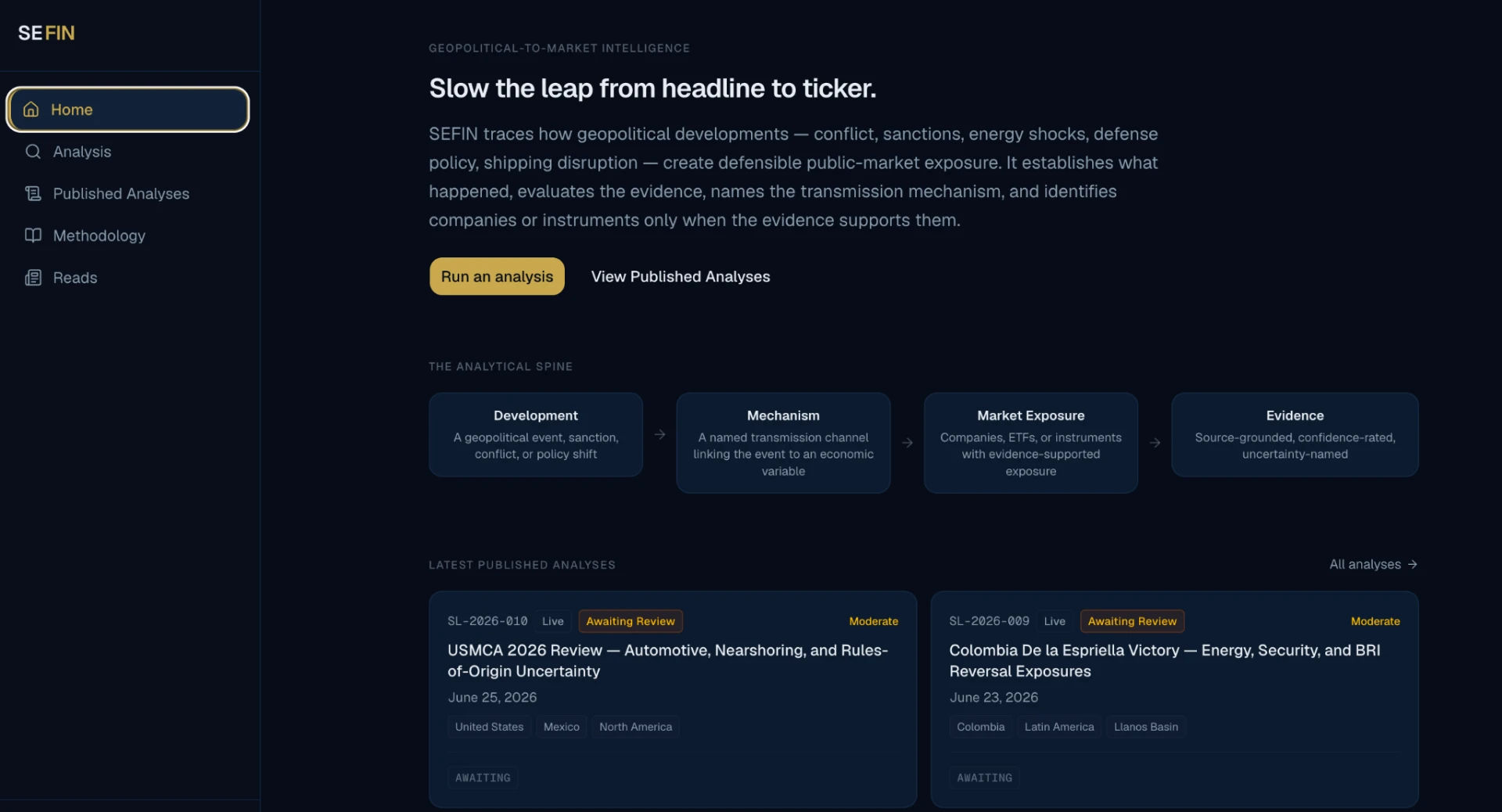
SEFIN.ai structures each situation around a single, repeatable chain. The goal is not to predict markets, but to make the reasoning behind an interpretation legible and checkable.
- Step 1
Development
A concrete geopolitical event: a policy change, a sanctions update, an election result, a supply-chain disruption. Verified before it is used.
- Step 2
Mechanism
The specific economic channel through which that development is expected to transmit into public markets — the causal path in plain language.
- Step 3
Exposure
The companies, ETFs, sectors, or regions plausibly touched by that mechanism — where the effect could show up. Exposure is not a judgment of investment attractiveness.
- Step 4
Evidence
The supporting material — filings, prices, statements, primary sources — presented with confidence and uncertainty made visible.
Development → mechanism → exposure → evidence.
Interface
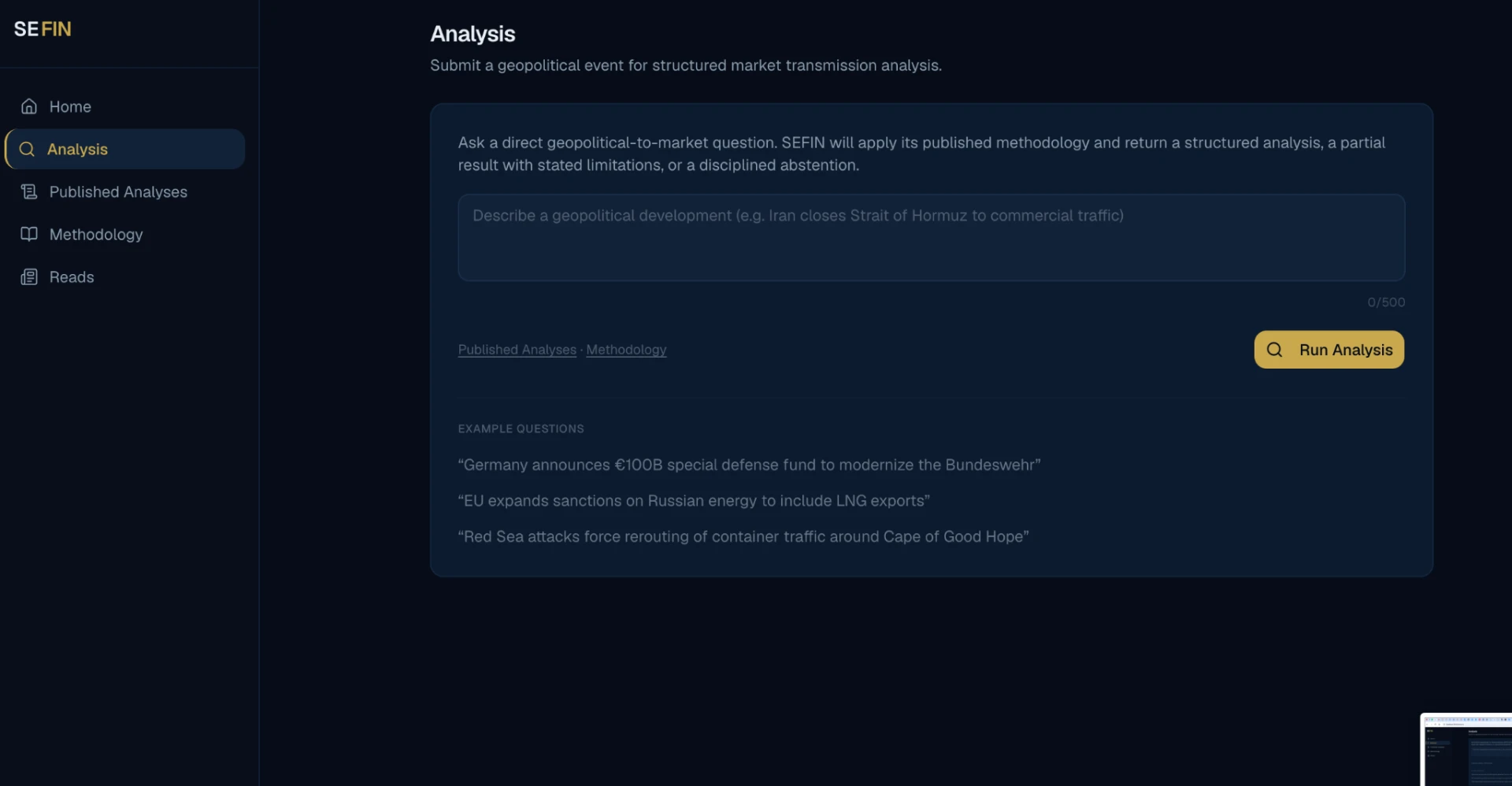
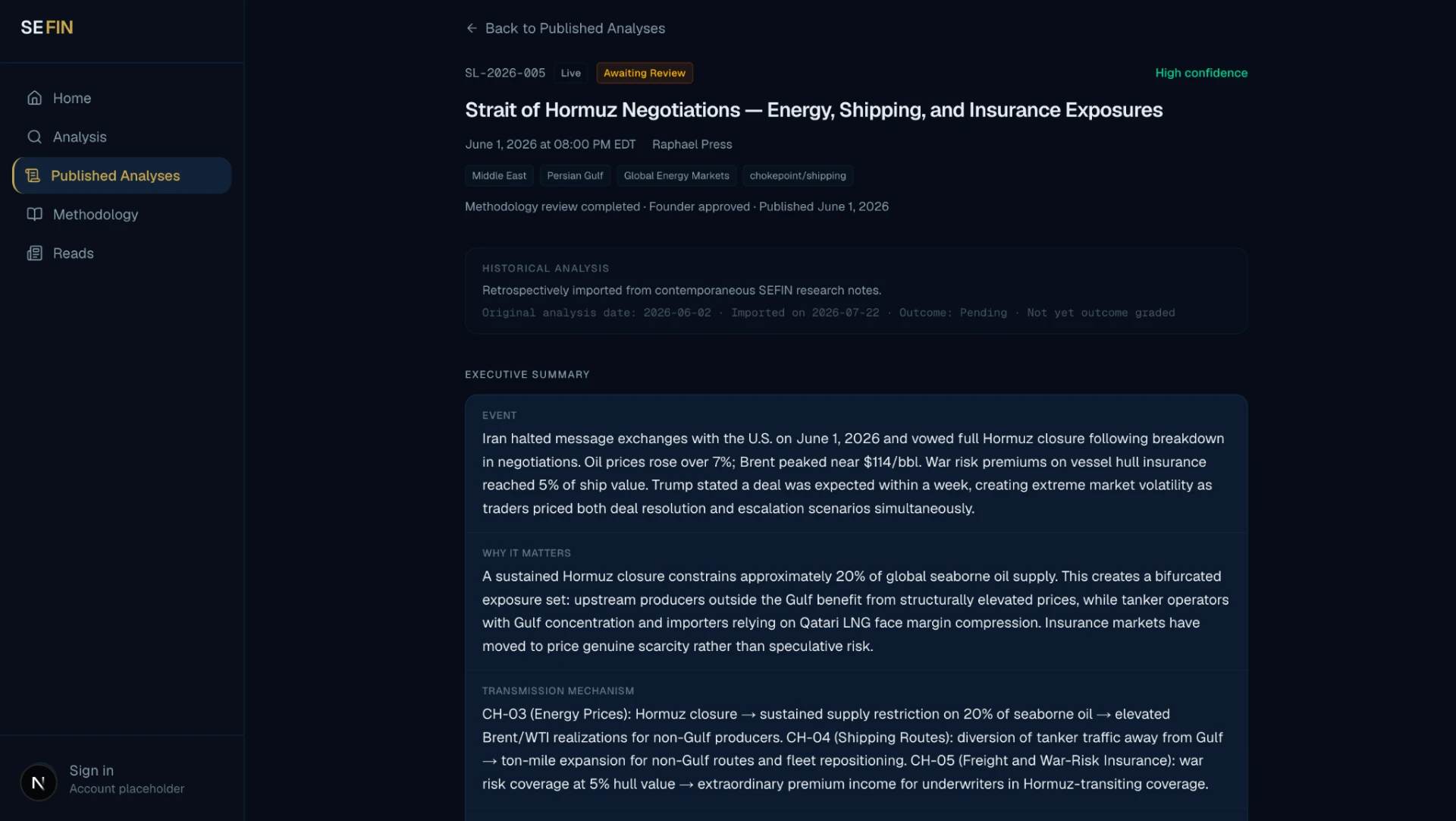
A few views from the current build. The product is still evolving; these represent the analytical spine in its V1 form.
Trust principles
Plain language first
Explanations are written to be understood, not to sound sophisticated.
Show the chain
Every claim ties back to a development, a mechanism, and evidence — not a floating assertion.
Uncertainty is visible
The tool distinguishes between what is documented, what is inferred, and what is speculative.
Sources over vibes
Primary sources sit alongside interpretations so the reader can check the work.
My role
I lead the product end-to-end: scoping what SEFIN.ai should and shouldn't be, designing the case structure, writing and editing cases, and building the AI-assisted workflows that keep the output consistent.
Practically, that means moving between three modes: product thinking (what belongs in a case), editorial (does this actually read clearly), and tooling (what should the model do vs. what should stay human).
Limitations
- Not investment advice, and not a stock picker.
- Exposure is not the same as investment attractiveness.
- Coverage is narrow by design; depth over breadth.
- Mechanisms are hypotheses, not predictions.
- AI outputs are reviewed, but errors and blind spots are still possible.